-
Generating Electricity from Crystals
-
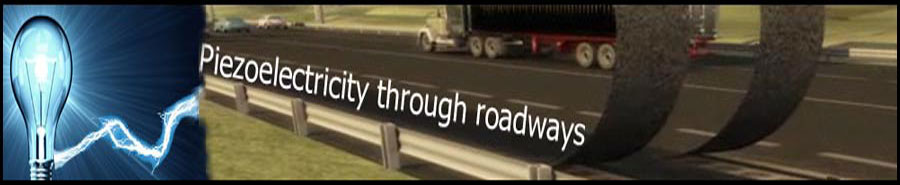
Conceptual Design of Piezo Roads
-
Versatility of Piezo Electricity

-
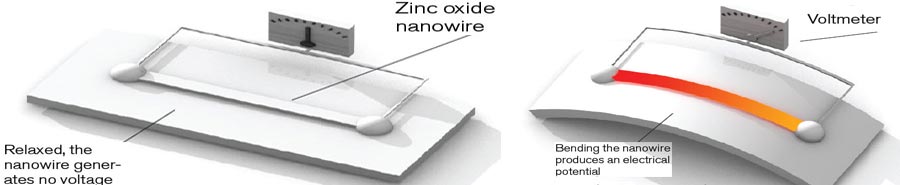
Representation of Change of Shape to generate current
-
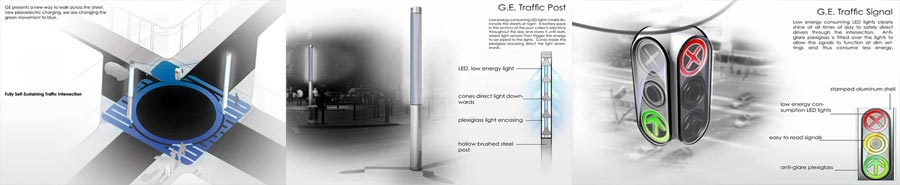
Practical Applications of Piezoelectricity





Crystals
Of the thirty-two crystal classes
(In crystallography, a crystallographic point group is a set of symmetry operations, like rotations or reflections, that leave a point fixed while moving each atom of the crystal to the position of an atom of the same kind. That is, an infinite crystal would look exactly the same before and after any of the operations in its point group. In the classification of crystals, each point group corresponds to a crystal class),
twenty-one are non-centrosymmetric (not having a centre of symmetry), and of these, twenty exhibit direct piezoelectricity (the 21st is the cubic class 432). Ten of these represent the polar crystal classes, which show a spontaneous polarization without mechanical stress due to a non-vanishing electric dipole moment associated with their unit cell, and which exhibit pyroelectricity.
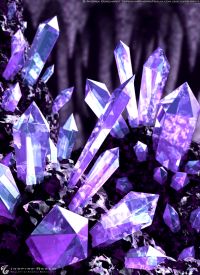 Piezo Crystals
Ferroelectricity is a property of certain materials which possess a spontaneous electric polarization that can be reversed by the application of an external electric field. The term is used in analogy to ferromagnetism, in which a material exhibits a permanent magnetic moment. Ferromagnetism was already known when ferroelectricity was discovered in 1920 in Rochelle salt by Valasek. Thus, the prefix ferro, meaning iron, was used to describe the property despite the fact that most ferroelectric materials do not contain iron.
Polar crystal classes: 1, 2, m, mm2, 4, 4 mm, 3, 3m, 6, 6 mm.
Piezoelectric crystal classes: 1, 2, m, 222, mm2, 4, 4, 422, 4 mm, 42m, 3, 32, 3m, 6, 6, 622, 6 mm, 62m, 23, 43m.
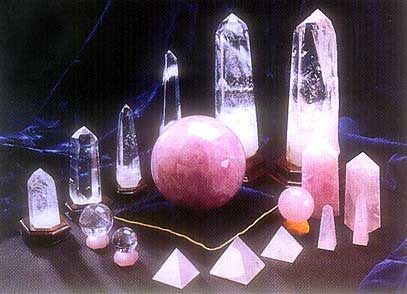 Piezo Crystals