-
Generating Electricity from Crystals
-
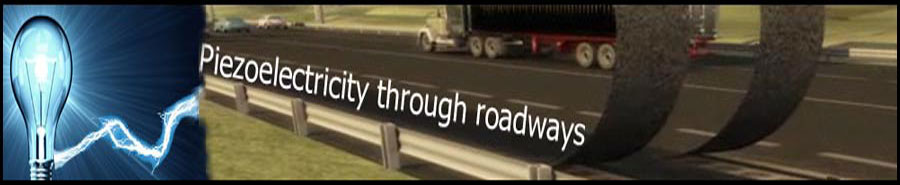
Conceptual Design of Piezo Roads
-
Versatility of Piezo Electricity

-
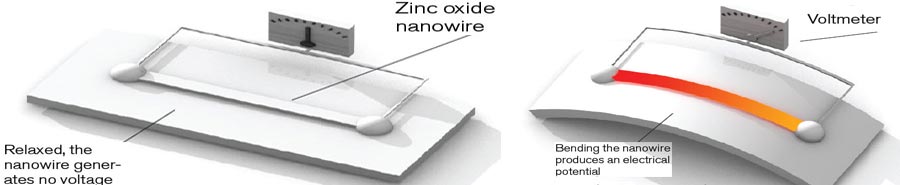
Representation of Change of Shape to generate current
-
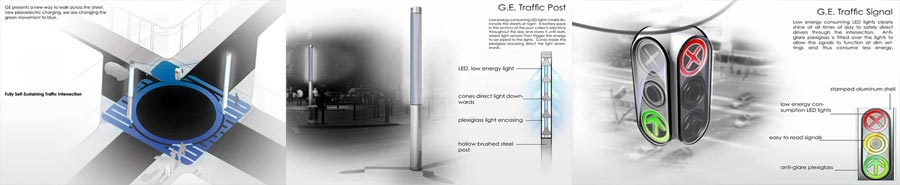
Practical Applications of Piezoelectricity





Mechanism
The nature of the piezoelectric effect is closely related to the occurrence of electric dipole moments in solids. The latter may either be induced for ions on crystal lattice sites with asymmetric charge surroundings (as in BaTiO3 and PZTs) or may directly be carried by molecular groups (as in cane sugar). The dipole density or polarization (dimensionality [Cm/m3] ) may easily be calculated for crystals by summing up the dipole moments per volume of the crystallographic unit cell. As every dipole is a vector, the dipole density P is also a vector or a directed quantity. Dipoles near each other tend to be aligned in regions called Weiss domains.
The domains are usually randomly oriented, but can be aligned using the process of poling (not the same as magnetic poling), a process by which a strong electric field is applied across the material, usually at elevated temperatures. Not all piezoelectric materials can be poled.
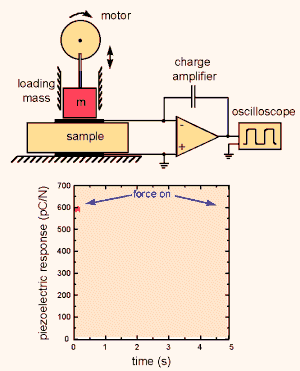 Representation of Piezo Generator
The orientation of P within the crystal, 2. crystal symmetry and 3. the applied mechanical stress. The change in P appears as a variation of surface charge density upon the crystal faces, i.e. as a variation of the electrical field extending between the faces, since the units of surface charge density and polarization are the same, [C/m2] = [Cm/m3]. However, piezoelectricity is not caused by a change in charge density on the surface, but by dipole density in the bulk. For example, a 1 cm3 cube of quartz with 2 kN (500 lbf) of correctly applied force can produce a voltage of 12500 V. Piezoelectric materials also show the opposite effect, called converse piezoelectric effect, where the application of an electrical field creates mechanical deformation in the crystal.