Actuators
As very high electric fields correspond to only tiny changes in the width of the crystal, this width can be changed with better-than-micrometer precision, making piezo crystals the most important tool for positioning objects with extreme accuracy — thus their use
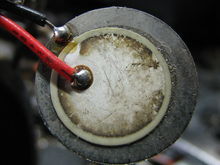
Metal Disk with Buzzer
in actuators. Multilayer ceramics, using layers thinner than 100 micrometres, allow reaching high electric fields with voltage lower than 150 V. These ceramics are used within two kinds of actuators: direct piezo actuators and Amplified Piezoelectric Actuators. While direct actuator's stroke is generally lower than 100 micrometres, amplified piezo actuators can reach millimeter strokes.
Loudspeakers: Voltage is converted to mechanical movement of a piezoelectric polymer film.
Piezoelectric motors: piezoelectric elements apply a directional force to an axle, causing it to rotate. Due to the extremely small distances involved, the piezo motor is viewed as a high-precision replacement for the stepper motor.
Piezoelectric elements can be used in laser mirror alignment, where their ability to move a large mass (the mirror mount) over microscopic distances is exploited to electronically align some laser mirrors. By precisely controlling the distance between mirrors, the laser electronics can accurately maintain optical conditions inside the laser cavity to optimize the beam output.
A related application is the acousto-optic modulator, a device that scatters light off of sound waves in a crystal, generated by piezoelectric elements. This is useful for fine-tuning a laser's frequency.
Atomic force microscopes and scanning tunneling microscopes employ converse piezoelectricity to keep the sensing needle close to the probe.
Inkjet printers: On many inkjet printers, piezoelectric crystals are used to drive the ejection of ink from the inkjet print head towards the paper.
Diesel engines: high-performance common rail diesel engines use piezoelectric fuel injectors, first developed by Robert Bosch GmbH, instead of the more common solenoid valve devices.
Active control of vibration using amplified actuators.
X-ray shutters.
XY stages for micro scanning used in infrared cameras.
Moving the patient precisely inside active CT and MRI scanners where the strong radiation or magnetism precludes electric motors.