Frequency standard
The piezoelectrical properties of quartz are useful as standard of frequency.
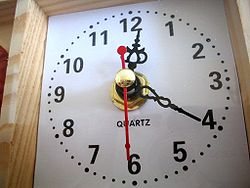
A Quartz Clock
Quartz clocks employ a crystal oscillator made from a quartz crystal that uses a combination of both direct and converse piezoelectricity to generate a regularly timed series of electrical pulses that is used to mark time. The quartz crystal (like any elastic material) has a precisely defined natural frequency (caused by its shape and size) at which it prefers to oscillate, and this is used to stabilize the frequency of a periodic voltage applied to the crystal.
The same principle is critical in all radio transmitters and receivers, and in computers where it creates a clock pulse. Both of these usually use a frequency multiplier to reach gigahertz ranges
Piezoelectric motors
Types of piezoelectric motor include:
The traveling-wave motor used for auto-focus in reflex cameras
Inchworm motors for linear motion
Rectangular four-quadrant motors with high power density (2.5 watt/cm3) and speed ranging from 10 nm/s to 800 mm/s.
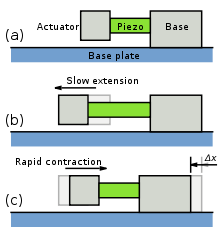
Stepping piezo motor, using stick-slip effect.

Slip-stick Actuator
All these motors, except the stepping stick-slip motor work on the same principle. Driven by dual orthogonal vibration modes with a phase difference of 90°, the contact point between two surfaces vibrates in an elliptical path, producing a frictional force between the surfaces. Usually, one surface is fixed causing the other to move. In most piezoelectric motors the piezoelectric crystal is excited by a sine wave signal at the resonant frequency of the motor. Using the resonance effect, a much lower voltage can be used to produce a high vibration amplitude.
Stick-slip motor works using the inertia of a mass and the friction of a clamp. Such motors can be very small. Some are used for camera sensor displacement, allowing anti shake function.