A tendon (or sinew) is a tough band of fibrous connective tissue that usually connects muscle to bone[1] and is capable of withstanding tension. Tendons are similar to ligaments and fasciae as they are all made of collagen except that ligaments join one bone to another bone, and fasciae connect muscles to other muscles. Tendons and muscles work together.
Silk
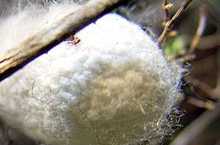
Silk Cocoon
Silk is a natural protein fiber, some forms of which can be woven into textiles. The best-known type of silk is obtained from the cocoons of the larvae of the mulberry silkworm Bombyx mori reared in captivity (sericulture). The shimmering appearance of silk is due to the triangular prism-like structure of the silk fiber, which allows silk cloth to refract incoming light at different angles, thus producing different colors.
Wood
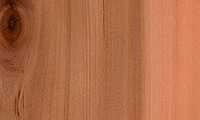
Wood
Wood is a hard, fibrous tissue found in many plants. It has been used for hundreds of thousands of years for both fuel and as a construction material. It is an organic material, a natural composite of cellulose fibers (which are strong in tension) embedded in a matrix of lignin which resists compression. In the strict sense wood is produced as secondary xylem in the stems of trees (and other woody plants). In a living tree it performs a support function, enabling woody plants to grow large or to stand up for themselves. It also mediates transfer of water and nutrients to the leaves and other growing tissues. Wood may also refer to other plant materials with comparable properties, and to material engineered from wood, or wood chips or fiber.
Enamel
Tooth enamel, along with dentin, cementum, and dental pulp is one of the four major tissues that make up the tooth in vertebrates. It is the hardest and most highly mineralized substance in the human body. Tooth enamel is also found in the dermal denticles of sharks. It is the normally visible dental tissue of a tooth because it covers the anatomical crown and must be supported by underlying dentin.
Dentin
Dentine (AE: dentin) is a calcified tissue of the body, and along with enamel, cementum, and pulp is one of the four major components of teeth. Usually, it is covered by enamel on the crown and cementum on the root and surrounds the entire pulp. By weight, seventy percent of dentin consists of the mineral hydroxylapatite, twenty percent is organic material and ten percent is water. Yellow in appearance, it greatly affects the color of a tooth due to the translucency of enamel. Dentin, which is less mineralized and less brittle than enamel, is necessary for the support of enamel.










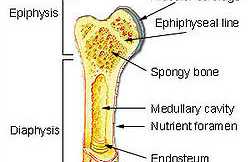 Bone : Femur
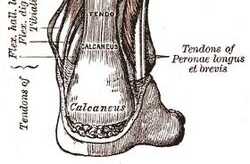 Achille's Tendon